GATE CSE 2019 Q12: Chip select AND gate on A15–A11: address range enabled
- Computer Organization and Architecture
- 1 mark
- MCQ
- −1/3 if wrong
Syllabus topic: Memory interfacing and hierarchy: performance and cache memory mapping
Question
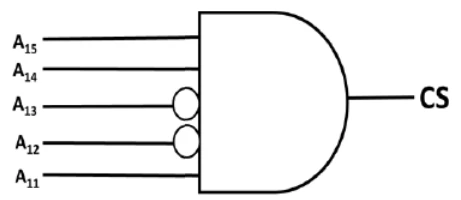
The chip select logic for a certain DRAM chip in a memory system design is shown below. Assume that the memory system has 16 address lines denoted by to . What is the range of addresses (in hexadecimal) of the memory system that can get enabled by the chip select (CS) signal?
Try it: multiple choice: exactly one correct option
Show answer and explanation
Answer: A (official GATE 2019 final answer key)
Concept used: Address decoding: CS is active only when the decoded high-order address bits match the gate's pattern; the remaining low bits range freely.
First step: Read off the required values of to (bubbled inputs must be 0), then let to vary from all 0s to all 1s.
Full step-by-step solution
Loading…
Answer from the official final answer key. Found a mistake? Use Report issue and we will fix it.
More questions on Memory interfacing and hierarchy: performance and cache memory mapping
Every PYQ on this topic →Share this question
Source: official GATE 2019 CS question paper and final answer key, organised by IIT Madras. Question paper · Answer key
More Computer Organization and Architecture PYQs
- 2026 Session 1 · Q14Match addressing modes with high-level data elements
- 2026 Session 1 · Q15Instruction sequence for Z = X + Y on a load-store machine
- 2026 Session 1 · Q16Register dependency that causes a data hazard
- 2026 Session 1 · Q36IEEE 754 single-precision sum of 35C00000 and 34A00000
- 2026 Session 1 · Q38Tag length: direct-mapped vs K-way set-associative cache
- 2026 Session 1 · Q54Impossible TLB / page table / cache event sequences