GATE CSE 2017 Session 2 Q31: Pairs to add to a five-element partial order to make a lattice
- Engineering Mathematics
- 1 mark
- NAT
- No negative marking
Syllabus topic: Sets, relations, functions, partial orders and lattices
Question
Consider the set under the partial ordering
The Hasse diagram of the partial order is shown below.
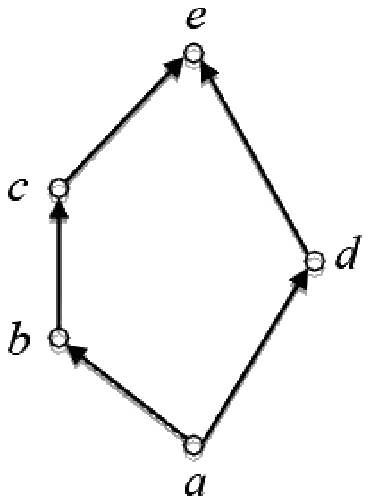
The minimum number of ordered pairs that need to be added to to make a lattice is ________.
Try it: numerical answer: type the value
Show answer and explanation
Answer: -0.01 to 0.01 (official GATE 2017 final answer key)
Concept used: A poset is a lattice when every pair of elements has a least upper bound and a greatest lower bound; the pentagon is a (non-distributive) lattice.
First step: Check every pair of elements, especially incomparable ones like and , for a unique join and meet.
Full step-by-step solution
Loading…
Answer from the official final answer key. Found a mistake? Use Report issue and we will fix it.
More questions on Sets, relations, functions, partial orders and lattices
Every PYQ on this topic →Share this question
Source: official GATE 2017 Session 2 CS question paper and final answer key, organised by IIT Roorkee. Question paper · Answer key
More Engineering Mathematics PYQs
- 2026 Session 1 · Q11Pólya urn: equal red and blue after two steps
- 2026 Session 1 · Q124×4 binary matrices with even parity in every row and column
- 2026 Session 1 · Q13Maximum multiplicity of an eigenvalue of an n×n real matrix
- 2026 Session 1 · Q20Matrix with e2 in its null space: determinant and rank
- 2026 Session 1 · Q32Continuity at 0 of c1·e^x − c2·ln(1/x)
- 2026 Session 1 · Q46Extrema and smoothness of (|x|/2 − x)(x − |x|/2)