GATE CSE 2023 Q62: Block accesses with a sparse primary index and binary search
- Databases
- 2 marks
- NAT
- No negative marking
Question
Consider a database of fixed-length records, stored as an ordered file. The database has 25,000 records, with each record being 100 bytes, of which the primary key occupies 15 bytes. The data file is block-aligned in that each data record is fully contained within a block. The database is indexed by a primary index file, which is also stored as a block-aligned ordered file. The figure below depicts this indexing scheme.
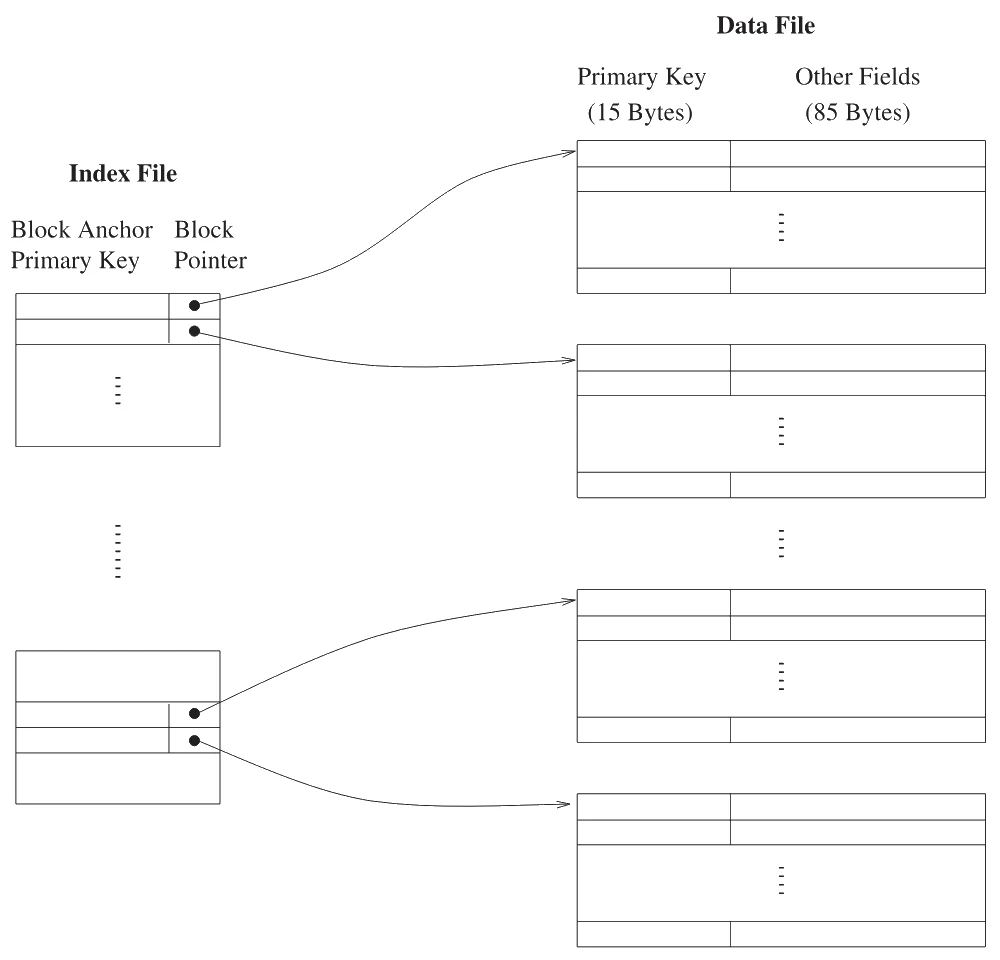
Suppose the block size of the file system is 1024 bytes, and a pointer to a block occupies 5 bytes. The system uses binary search on the index file to search for a record with a given key. You may assume that a binary search on an index file of blocks takes block accesses in the worst case.
Given a key, the number of block accesses required to identify the block in the data file that may contain a record with the key, in the worst case, is _______.
Try it: numerical answer: type the value
Show answer and explanation
Answer: 6 (official GATE 2023 final answer key)
Concept used: A sparse primary index has one entry per data block; binary search runs over the index blocks.
First step: Find the number of data blocks ( records per block), which is the number of index entries.
Full step-by-step solution
Detailed working, common mistakes and linked mock tests will be available with a free GATEiit account. Log-in is coming soon.
Share this question
Source: official GATE 2023 CS question paper and final answer key, organised by IIT Kanpur. Question paper · Answer key
More Databases PYQs
- 2026 Session 1 · Q30Which functional dependency inferences always hold
- 2026 Session 1 · Q31Dependency-preserving decompositions for 1NF, 2NF, 3NF, BCNF
- 2026 Session 1 · Q43Relational algebra equivalent of a tuple calculus join query
- 2026 Session 1 · Q65Number of superkeys with candidate keys {A,B} and {A,C}
- 2026 Session 2 · Q15Match DBMS schema levels with what they describe
- 2026 Session 2 · Q20When two transactions do not conflict on a data item