GATE CSE 2021 Set 2 Q55: Distance vector update at R from neighbours X, Y, Z
- Computer Networks
- 2 marks
- MSQ
- No negative marking
Question
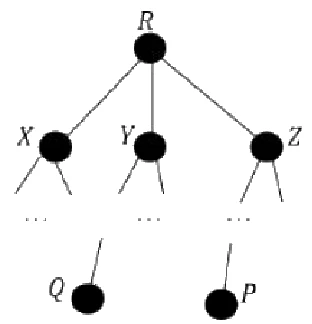
Consider a computer network using the distance vector routing algorithm in its network layer. The partial topology of the network is as shown below.
The objective is to find the shortest-cost path from the router to routers and . Assume that does not initially know the shortest routes to and . Assume that has three neighbouring routers denoted as , , and . During one iteration, measures its distance to its neighbours , , and as 3, 2, and 5, respectively. Router gets routing vectors from its neighbours that indicate that the distance to router from routers , , and are 7, 6, and 5, respectively. The routing vector also indicates that the distance to router from routers , , and are 4, 6, and 8, respectively. Which of the following statement(s) is/are correct with respect to the new routing table of , after updation during this iteration?
Try it: multiple select: one or more correct options
Show answer and explanation
Answer: B, C (official GATE 2021 final answer key)
Concept used: Bellman–Ford update: , and the next hop is the minimising neighbour.
First step: For P compute , , ; for Q compute , , .
Full step-by-step solution
Detailed working, common mistakes and linked mock tests will be available with a free GATEiit account. Log-in is coming soon.
Share this question
Source: official GATE 2021 Set 2 CS question paper and final answer key, organised by IIT Bombay. Question paper · Answer key
More Computer Networks PYQs
- 2026 Session 1 · Q18True statement about TCP connection setup and closing
- 2026 Session 1 · Q19HTTP 1.1 persistent connections and pipelining
- 2026 Session 1 · Q44When segment 2000 is sent under TCP slow start
- 2026 Session 1 · Q45Minimum sliding window size for full link utilisation
- 2026 Session 1 · Q56Valid CIDR blocks for 6000 addresses inside 202.16.0.0/15
- 2026 Session 2 · Q21File transfer time over three links of different bandwidth